

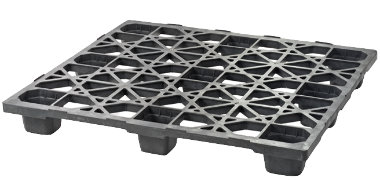


Seems like a straightforward question, right? Well, if we’re talking about standard 48×40 plastic pallets, I can tell you that we’ve got 26 to 30 skid spots to work with on a typical 53′ dry van tractor trailer. Next comes some basic math (and maybe a tape measure). Most times we can come up with a solid count. Every once in a while we run up against an exception – usually because of a change in the truck scheduled to pick up the load.
Basic Assumptions
I’ve put some diagrams below to help illustrate how we figure out how many spots we have available on a 53′ truck for our most popular plastic pallet sizes. Before we jump in, I need to point out some basic assumptions:
-
Standard Dry Van
A dry van is a rectangular trailer that measures 53 feet long. For our calculations, we’re assuming average interior dimensions of 98″ wide x 632″ long. Not every trailer is identical, of course. Trailer widths can vary from 98″ to 102″ and the length can sometimes get cut short due to design variations. This is where a tape measure comes in handy if you want to be extra sure your desired loading pattern will fit. -
Turned Loading Pattern
As you’ll see below, we can usually fit many more rectangular pallets on a truck if we “turn” the pallets. Turning only works if the pallet has a 4-way entry base for your forklift. Unlike wooden pallets, nearly all plastic pallets are 4-way. A 2-way pallet can still be turned if the pallets are lightweight enough for hand-loading. -
Skid Spots
For today’s discussion I’m limiting calculations to skid spots. Spots refer to how many pallet stacks can fit in the trailer. Every plastic pallet’s stack count varies with its design. Our nestable plastic pallets may have a stack count as high as 78 but one of our full perimeter rackable pallets may only hold 17 in a stack. How high can we stack? The average trailer is 108″ high but can vary from 100″ to 114″.
Skid Spots on a 53′ Truck per Pallet Size
48×40 Standard Plastic Pallets
To minimize shipping costs (especially when buying a truckload of new plastic pallets) we load 48×40 plastic pallets in a turned pattern. We can load 30 stacks of 48×40 pallets into a 53′ trailer (26 stacks if the pallets need to be loaded straight).

48×32 Euro Plastic Pallets
The turned configuration allows us to load 38 stacks of 48×32 pallets stacks into a 53′ truck but the slimmer width of a Euro pallet sometimes allows us to gain one extra skid spot by loading straight.

48×45 Automotive Plastic Pallets
Once again, a turned loading pattern may allow us to fit more stacks on the truck – but often not. We sometimes can load 28 stacks of 48×45 pallets into a 53′ trailer (26 stacks if the pallets are loaded straight). Tip: measure first. Depending on the truck or pallet, you may find the turned loading pattern only fits 26 stacks. The 48×45 size is popular in the automotive industry (meets AIAG specs) but also works well in any industry using Gaylord boxes.

Square Plastic Pallets
Since all sides are equal on square pallets, there’s only one way to load. Assuming a standard 53′ trailer, we can load 28 stacks of 43×43 plastic pallets. 45×45 plastic pallets can sometimes fit 28 stacks, but variations in pallet and truck designs often reduce that count to 26. Square pallets are popular in the feed, chemical and additive industries for stacking Super Sack® bulk bags. Similarly, we can load 26 stacks of 48×48 drum pallets.

Other Options for Transporting Pallets
In today’s post I focused on loading popular pallet sizes into a standard 53-foot dry van trailer, but there are many more types of trucks making pallet deliveries. A reefer truck (a refrigerated trailer) can also be 53′ but often loses loading space due to insulation on the interior. LTL trailers are used to transport less-than-truckload quantities. LTL trucks are not just shorter in length (28′ on average) but most are less tall too. Other truck sizes on the road include lengths of 24′, 40′, 45′ and 48′ with enclosed trailers and without (flatbeds). Finally, shipping containers (used for ocean transport) have lengths of 20′ and 40′.
What type of truck do you use for transporting pallets? Would you like to see a blog post detailing how many pallets fit on a truck that is not a 53′ dry van? Let’s connect below.
Acronyms, abbreviations, shorthand and jargon make up the freight and billing lexicon we use in the shipping world. Many of these commonly used terms can leave people scratching their heads. In this post, I’ll help to clear up questions about some of the most popular freight and billing terms you might see on shipping documents.
Common Freight and Billing Terms
Below are some of the terms everyone working in (or with) the freight industry should know.
-
BOL
Bill of Lading
A legal document between the shipper of a particular good and the carrier. A BOL details the type, quantity and destination of the good being carried.The bill of lading also serves as a receipt of shipment when the good is delivered to its predetermined destination. This document must accompany the shipped goods (no matter the form of transportation) and must be signed by an authorized representative from the carrier, shipper and receiver.
-
Consignee
Consignee
This is the individual or business that receives the freight being shipped. -
DE PPD or DSTNTN-PPD
Destination Prepaid
This means that the buyer is taking delivery of goods being shipped by a supplier. After the goods arrive at the buyer’s receiving dock, the supplier pays the shipping costs. -
FFA
Free Freight Allowance or Forward Freight Agreement
Both meanings here are associated with how much a customer will be charged for freight. Free Freight Allowance allows for discounted shipping charges (usually issued when a customer reaches a certain volume or dollar amount). A Forward Freight Agreement is used when both parties agree on freight charges for future delivery. Since freight rates are always changing, both sides are gambling on rates going up or down (in their favor) at the time of shipment. -
Freeze Protect
Freeze Protect
This means the shipper is requesting freeze protection while the product is in transit. The product will not be in an environment where the temperature will drop below 32 degrees. Only certain carriers offer this type of protection. -
Freight Collect
Freight Collect
This term means the freight will be paid by the person receiving the shipment. -
FOB
Free on Board
This acronym officially stands for Free on Board as defined by the Uniform Commercial Code but informally you may also hear Freight On Board. The term FOB is commonly used to indicate who pays loading and transportation costs, and/or the point at which the responsibility of the goods transfers from shipper to buyer. -
FOB Shipping Point, FOB-SP or FOB Origin
FOB Shipping Point
Indicates the buyer pays shipping cost and takes responsibility for the goods as soon as the goods leave the seller’s premises. -
FOB Destination
FOB Destination
Designates the seller will pay shipping costs and remain responsible for the goods until the buyer takes possession. -
LTL and TL
Less Than Truckload and Truckload
LTL is an acronym for Less Than Truckload. This means the shipment does not require a full 48 or 53 foot trailer. There are many carriers that specialize in or offer this service.Like full truckload carriers, LTL carriers specialize in a variety of services such as lift gate and residential pick-ups; deliveries; guaranteed services; protect-from-freeze; transit and bottom-line-cost to name a few. Rates for LTL freight are determined by class, weight, pick up and destination zip code.
TL is an acronym for Truckload. The quantity of freight required to fill a trailer; usually more than 10,000 pounds.
-
ORG
Origin
This identifies the starting location for the freight or shipment. -
PPA, PP&A or PPD & Add
Prepaid and Add
This means the shipper pays for the freight charges using their preferred carrier and then passes along full (or partial) charges by adding the charges to customer’s invoice for payment. -
PPD 3rd
Prepaid Third Party
This is when the shipper pays for the shipping charges through a 3rd party broker logistics company. -
PP-PRTL
Prepaid Partial Truckload
When a load is too big to meet LTL standards but is still shy of a full load, it’s called a partial truckload. If you see PP-PRTL, it means the customer agrees to prepay the shipping charges for a partial truckload. -
PRO Number
Pro Number
Sequential numbering system that is used to identify freight bills. A Pro number is like a social security number for your shipment because it is unique to every individual shipment. -
TPB
Third Party Billing
This is a scenario where neither the shipper nor the consignee is responsible for paying the freight charges. Instead there is a third party who is responsible for the charges. -
ZDD
Zero Delay Delivery
Basically this one means fast shipping with the goal of items being delivered on time.
Need a Freight Term Defined?
I hope you found what you were looking for. Shipping stuff seems easy enough, but sometimes it feels like you have to learn a secret new language just to get a freight bill paid. What other terms have you seen on freight paperwork? Let’s connect so I can add the term and definition to my post.