



ALWAYS INNOVATING
Yesterday's boxes, reels, and pallets still triumph today — only better.

Boxes
Wood tinplate boxes grew through WWII to include crates shipping Martin Bomber parts overseas. Today our Tech Center designs durable custom crates with testing labs that reduce product-damage losses.

Reels
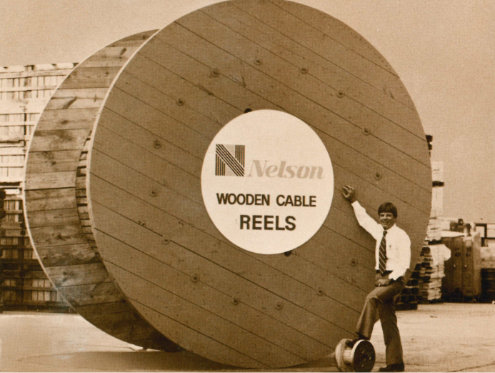
Reel manufacturing rolled onto our line in the 1940s so successfully that by the 1970s Nelson built the largest nailing machine ever made — for assembling 160″ wood reels.

Pallets
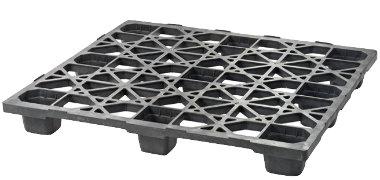
Originally nailed by hand with a hammer or hatchet, then sped up by pneumatic guns. Advances in recycled-material technology now add plastic pallets to our full line of palletizing solutions.
At the Nelson Company, we recognize when change is needed or coming and go right at it. Don't hold onto the old when it no longer makes sense. Always keep moving forward.

THE TRAILBLAZER
A man who literally blazed trails.
After a BA from Johns Hopkins in 1903, John M. Nelson, Jr. joined the very first graduating class of the Yale University Forest School. Working for the US Forest Service under President Theodore Roosevelt, he rode horseback across the West, helping identify sites recommended for national park status.
In 1909 he patented a method for treating timber with liquid preservatives to prevent decay. Two years later, with just two employees and a thousand dollars, he opened a wholesale lumber company in Pottsville, Pennsylvania. Acting on a hunch in 1918, he moved to Baltimore and led the company into entirely new territory.

A BOLD BET ON BALTIMORE
A chance encounter, a leap of faith.
In 1918 Jack ran into an old Baltimore friend who'd just taken a management job at Bethlehem Steel's newly-acquired operations — and learned of a bid to build wood boxes for a new tinplate mill. Jack had never built tinplate boxes, but taking risks was in his blood.
His gamble paid off on October 27, 1919, when he signed what became the oldest continuous contract in Bethlehem Steel history. By 1920, ninety percent of Nelson's income came from the Point — 350 workers punched in around the clock, moving every board by push cart and hand.
"Give the customer what they need, not what we prefer to supply."

SAILING THROUGH THE DEPRESSION
How a sailboat kept the plant alive.
An enthusiastic sailor, Jack faced the Great Depression determined to avoid layoffs. His idea: build a large sailboat inside the Sparrows Point box plant. Aviation pioneer Glenn L. Martin caught wind of the unusual endeavor — and it sparked a meeting.
That relationship made Nelson the Martin Company's box supplier throughout World War II, holding airplane parts including the fuselage of the "Martin Bomber." The boat, Penrith — named for the English birthplace of the first Nelson in America — "paid for herself many times over."

A CENTURY IN ONE CAREER
The chairman who saved the company.
If there's one person at The Nelson Company today who embodies John M. Nelson, Jr.'s work ethic, enthusiasm, and personality, it's Chairman of the Board A. P. Caltrider — "Pete." He has been part of the company for more than half its 100+ year history, and is the only current employee lucky enough to have met and worked for the founder himself.
After serving in the US Navy, twenty-three-year-old Pete interviewed for office work to support his growing family. In 1958 The Nelson Company offered him a job — and his short-term goal of a steady income was quickly surpassed as he learned the industry, mastered the business, and eventually purchased the company.
When the Nelson family sold to a larger conglomerate, Pete recognized the small subsidiary wasn't likely to fit its new owner's long-term plan. In the early 1980s he and three officers devised a plan to buy the company back. Without Pete's forethought, The Nelson Company would sadly have been forced into liquidation.
"Keep working at what you are doing. You never know when the little thing will become the big thing. This is the best lesson I have learned from the Nelson Company." — Pete Caltrider, Chairman
TODAY'S NELSON FAMILY
The same values, carried forward.
More than a century on, The Nelson Company is still led by people who treat it like family — because they are one. What began with founder John M. Nelson, Jr. passed to his son, John M. Nelson III, and was rescued and rebuilt by Chairman Pete Caltrider.

A. P. “Pete” Caltrider
Chairman of the Board
Joined in 1958, purchased the company, and led the 1981 buy-back that saved it from liquidation. Still the heartbeat of Nelson's work ethic and enthusiasm.

David Caltrider
CEO & President
Joined full-time in 1998 to expand Nelson across the East Coast, and in 2005 purchased majority ownership with his best friend, continuing the family's hands-on leadership.

John G. “Jack” Williams
CFO & EVP
Joined full-time in 1986 and, alongside David Caltrider, purchased majority ownership in 2005 — keeping Nelson independent and privately held.

Richard M. “Rich” Reiher
Vice President
Joined full-time in 2001 in sales and business development, worked up through the ranks to Vice President, and purchased a minority interest in the company in 2018.
TRAILBLAZING TIMELINE
A century of moving forward.
Associated Box opens in New Castle, Pennsylvania and is later acquired by Nelson Company.
John M. Nelson, Jr. Inc. launches as a lumber supplier in Pottsville, Pennsylvania.
Bethlehem Steel opens in Sparrows Point, Maryland as one of the largest tinplate manufacturers.
John M. Nelson, Jr. Inc. expands with a branch office in New York City.
The Nelson Company opens a new office at 10 E Fayette St, establishing headquarters in Baltimore, Maryland.

Contract signed with Bethlehem Steel on October 27 to supply tinplate boxes.
Company name changes to The Nelson Company.
Production begins at Bethlehem Steel. 350 workers punched-in around the clock with manual lumber handling.
High-lifting fork trucks gain momentum in materials handling.
Pallet references increase in trade publications after 1920s introduction.
Nelson begins manufacturing wood and plywood wire and cable reels.
Nelson becomes Martin Company’s box supplier for airplane parts, including the Martin Bomber fuselage.
Wartime integrates 4-way pallets into U.S. military logistics strategy.
Nelson adds corrugated products including circles, donuts, wrappers, cartons, slipsheets, and angle board.
A. Pete Caltrider joins Nelson Company.
Nelson becomes a subsidiary when sold by founder’s son, John M. Nelson III.
A.P. Caltrider becomes President.

Nelson works with a machine company to design the largest nailing machine for 160″ wood reels.
Reverse Distribution Services introduced, saving customers 10%–50% through asset reuse management.
A. Pete Caltrider pilots buyback and purchases full ownership with John K. Williams.
Jack Williams joins as full-time employee, later becomes CFO and Executive Vice President.
David Caltrider joins full-time to expand operations along the east coast, later becomes CEO and President.
Nelson invests in reverse distribution management software, later named Nelson-ART™.
Rich Reiher joins full-time in a sales capacity, later becomes Vice President.
DuPont selects Nelson Company for its first Supplier Recognition Award.
David Caltrider and Jack Williams purchase majority ownership.
A. Pete Caltrider celebrates 50 years with the company as Chairman.
Nelson celebrates 100th anniversary of Founder’s Day.
The Nelson Technical Center opens to design new packaging systems for enhanced sustainability.
Old plant and office at Sparrows Point are demolished.
Nelson Company celebrates 100 years in Baltimore.
Rich Reiher purchases a minority interest in the company.
OUR FOUNDER
John M. Nelson, Jr.
The story of our founder is one for the history books — a man so accomplished he literally blazed trails.
Meet JackFREE KEEPSAKE
Get the Booklet
Celebrating Founder's Day shares the story of great courage, unrelenting perseverance, and an unwavering commitment to integrity and family values.
Request Your Copy