

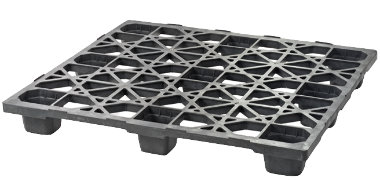


Rackable pallets (plastic or otherwise) are pallets that are expected to bridge an open span. Much like the Brooklyn Bridge suspends high above the rushing waters of the East River, a rackable pallet spans a distance between supports in a rack.
What is a Pallet Rack?
You may be scratching your head right about now so let’s back up a little. Pallet rack? What the heck is a pallet rack? Any conversation about rackable pallets needs to start with the various types of pallet racks found in industry. This post will identify seven of the most common racking systems used with rackable pallets.

Many beams have a step on the inside edge for use with support structures.
1. Beam Rack
This is a typical shelf-like structure with steel uprights and horizontal beams front and back. The pallet sits on the beams. The “span” being bridged is the distance of open space front to back.
2. Edge Rack
Typically designed to drive in with a lift truck, this type of rack has rails often made of steel angle iron running perpendicular to the aisle. The pallet sits on the rail and the span being bridged is the distance between the rails.
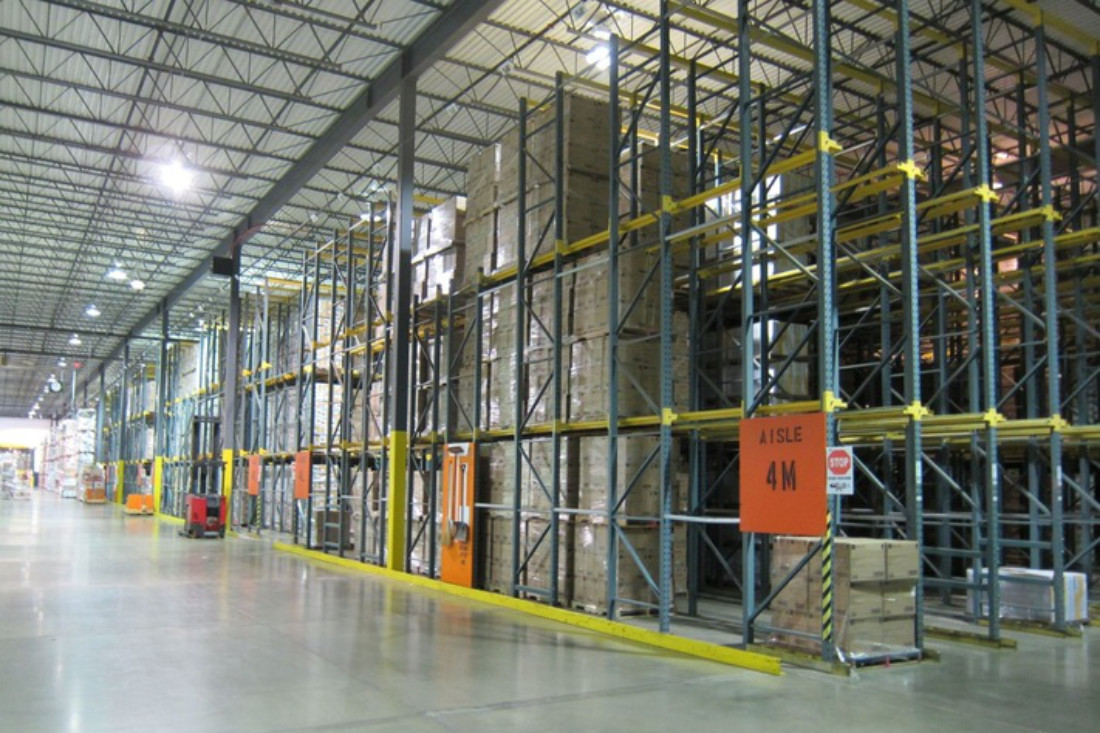
Edge rack drive-in systems usually have a common entry and exit point for each aisle.

Rollers allow pallets to easily slide into position.
3. Roller Rack
These are racks designed with rollers positioned at the pallet’s contact points. These can look just like an edge rack but instead of simple angle iron, the rails are replaced by rollers. The span in this case would be similar to the edge rack.
4. Push-Back Rack
This type of racking system employs an intrinsic platform that is loaded and then pushed back perpendicular to the aisle. The most efficient systems have platforms that deploy from on top of one another, exposing the next platform as the top one is pushed back. In this case the design of the platform would determine the span that would need to be bridged.
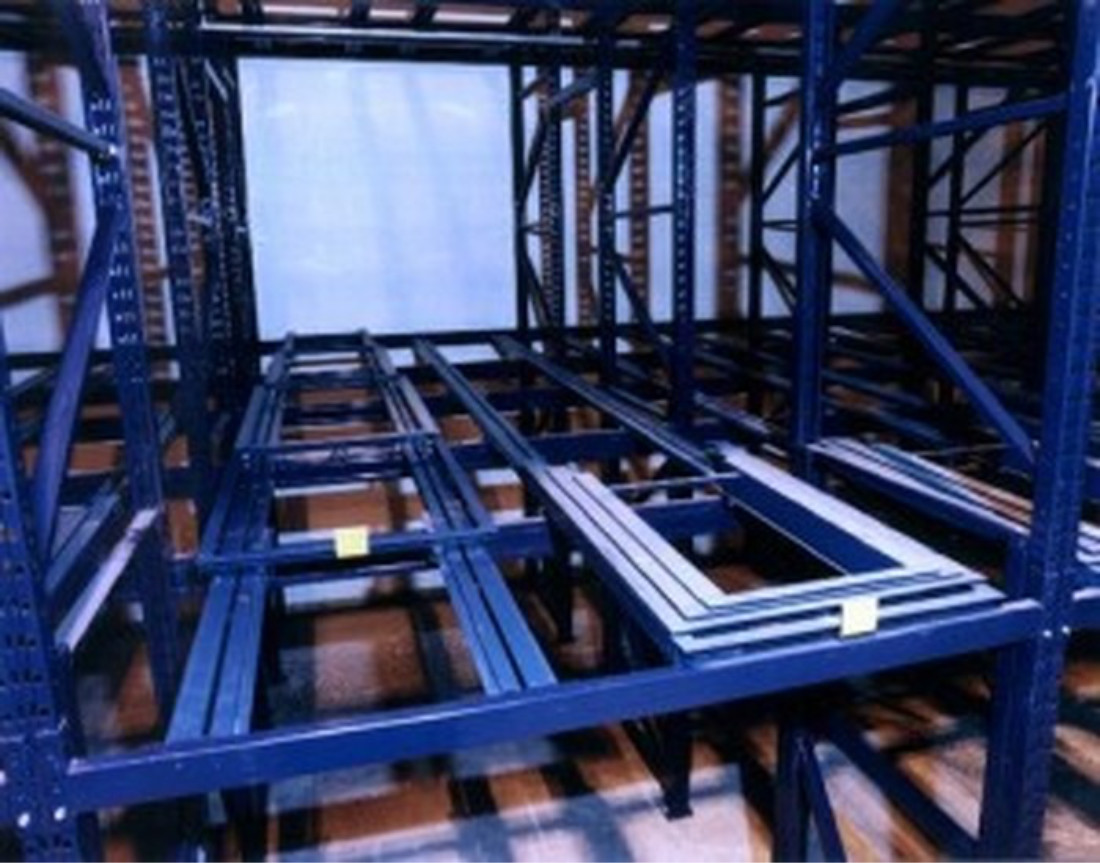
Storage density is increased when using a push-back rack.
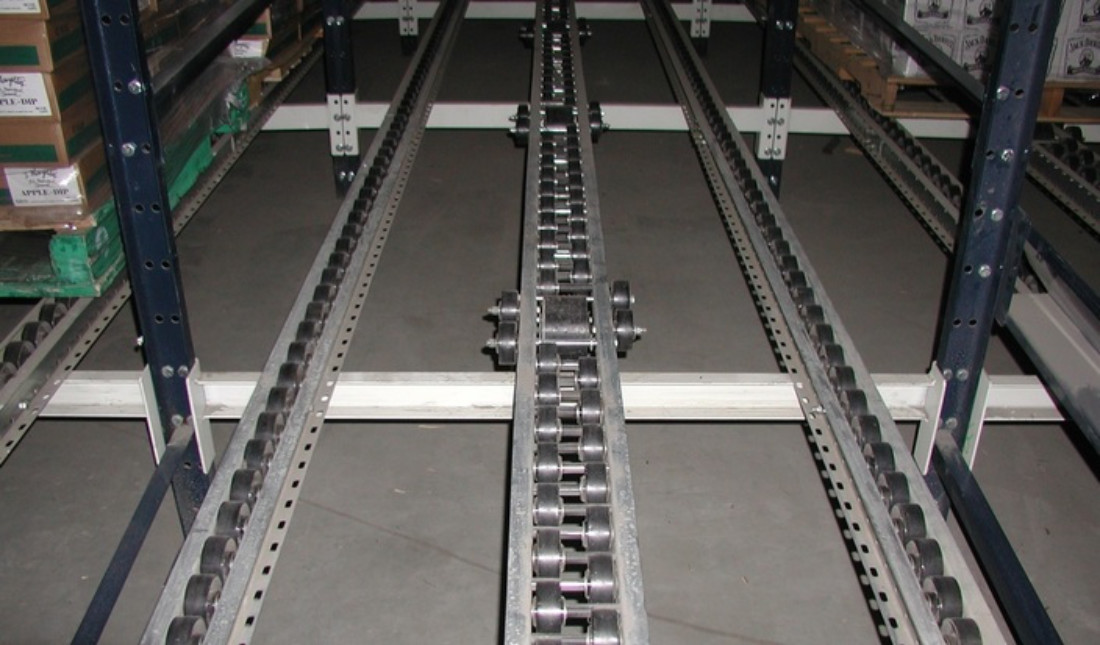
Flow racks may also be referred to as gravity flow racks.
5. Flow Rack
These racks are designed to allow pallets to be loaded in one side of the rack and flow through the rack, usually by gravity, to be removed from the other side. Often designed with 3 sets of rollers perpendicular to the aisle, the roller sets would be on a slight downward angle from entry to exit allowing gravity to move the pallet through the rack. Sometimes there are “brake wheels” installed mid-way on the racks to slow pallets down on their way to the other side. In most cases, there would be a center set of rollers making for a short span.
6. Cantilever Rack
This rack has uprights parallel to the aisle with support beams cantilevered out from the uprights, perpendicular to the aisle. These racks are most often used for long items that would not fit into a conventional rack with uprights in the way every 8 feet or so. Pallets used in these racks are almost always custom designed to the specific product they are meant to carry.

Cantilever racks almost always require custom-made rackable pallets.

A supported rack opens up options for rackable pallet choices because there is no span!
7. Supported Rack
This is usually a beam rack with some kind of support structure that helps with the span from front to back. This could be a series of spanning bars fit perpendicular to the beams front to back, or my personal favorite, the wire deck. In this case a section of heavy gauge wire mesh is placed on the beams, often with extra support members to hold whatever is placed in the rack.
Most Common Racks
You now know the seven most common types of racks used with rackable pallets. I avoided the panoply of custom solutions, sophisticated AS/RS, stacker-crane systems and the like as each really needs to be evaluated on its own.
Still have questions about pallet racks? Let’s connect. Watch for my upcoming post which will go into detail about how pallets interact with racks. Yes, Virginia, thus making them rackable!
Use of racking system photos used with permission from our friends at Warehouse Rack & Shelf, LLC.
Use of Pallet Flow by Markj52 licensed under the Creative Commons Attribution 3.0 Unported license.
The Food Safety Modernization Act (FSMA) is a group of regulations signed into law in 2011. The act is meant to apply the best available science and good common sense to prevent the problems in food production, storage and transportation that can make people sick.
Why do we Need new Regulations? Isn’t our Food Supply Safe?
Yes, for the most part it is. Still, one in 6 Americans become sick, 128,000 are hospitalized and 3,000 die each year from food-borne diseases (CDC). The intention of this law is to prevent food-borne illness before it happens.
What will the FDA be Looking for?
The FDA puts it rather bluntly. They mention bacterial or chemical contamination caused by:
- Filth
- Decomposition
- Unsanitary Conditions
What does this Mean for Pallets?
FSMA is broken down into 7 main sections, but for pallet use, it gets pretty simple:
- Preventive Controls for Human Food
- Preventive controls for Animal Food
- Produce Safety
- Sanitary Transportation
Who will the FDA be Inspecting?
Considering that pallets may well be the single most ubiquitous item in the food supply chain, it is not an overstatement to say that the FDA will be looking at YOUR pallets and how they will or will not contribute to your efforts to comply with the FSMA. To comply, your pallets must be:
- Easy to keep clean
- Non-toxic
- In good repair
How Should I Prepare?
Have a plan. The FDA man will be going where no FDA man has gone before. Even if you have never seen an FDA uniform, be prepared. This act has teeth and congress has given the FDA the full funding they will need to use them. Whether you are a processor, shipper, carrier or receiver of food products, ask a pallet professional today about solutions available to keep you in compliance – before an inspection.
Still not sure if your pallets are ready for FSMA? Let’s connect. Post your questions or concerns below and we’ll be happy to discuss some of the important details of the FSMA that have rolled out.
Use of FDA Inspector photo is made available by the U.S. Food and Drug Administration.
Has searching for FDA approved plastic pallets left you with confusion and sticker shock? Save money (and avoid buying the wrong pallet) with these tips for understanding what the FDA really wants in your pallet application.
Complying with FDA Pallet Regulations
You work with packaged food or pharmaceuticals and you’ve been told you need to purchase an inventory of FDA approved plastic pallets. You’re not even sure you know what that means. Worse, the thought of complying with government regulations sounds complicated. Don’t worry. Finding the right pallet is often easier than it first appears.
The FDA Code of Federal Regulations can seem confusing but it boils down to this: the FDA is concerned with the design, workmanship and material used in equipment meant to handle food and drugs (Title 21 CFR part 100.40).
What does this mean for Incidental Product Contact?
-
FDA pallets need to be easy to clean
Hidden areas can trap debris or liquid which can foster contamination and bacteria growth causing adulteration of your product. -
FDA pallets need to be non-toxic
The FDA does ban some substances outright and your pallets cannot contain them if they are to be used in a regulated facility. -
FDA pallets need to be in good repair
Broken or dilapidated pallets can become part of the dangers of contamination rather than part of the solution. Broken pallets become hard to keep clean and pieces of broken pallets can end up in product.
Bottom Line from the FDA on Plastic Pallets
When asked specifically about pallets, the FDA has answered repeatedly that for incidental product contact, a pallet must simply not pose an intrinsic hazard. Easy, right? It doesn’t even have to be blue. For most applications, the less expensive standard black plastic pallets will be approved for use in FDA regulated applications.
So now you know the basics for using plastic pallets in FDA regulated facilities. When there is general, incidental product contact, a standard plastic pallet may be all you need. If your product contact is not incidental, you’ll need to use FDA Pallets qualified for FULL PRODUCT CONTACT.
Still not sure about which plastic pallet will work best for your FDA requirements? Let’s connect. Tell us how you use pallets with your product or post your questions below.
Today, the term can refer to any pallet-sized container made of corrugated cardboard or a number of pallet-sized plastic or even metal containers. Sizes usual have a footprint of 48×40, 48×48 or 48×45. Sidewall heights usually vary from 24 to 50 inches.
Low Cost Corrugated
First introduced in the 1930’s, the corrugated Gaylord box was designed as a low cost way of moving bulk material. By the 1950’s, these versatile containers were being used to move everything from plastic resin to watermelons.
The intentional choice of corrugated paper meant these boxes were never really expected to be reusable. Heck, even for commodities, the cost of the box was easily figured in with the product it contained. Even though there has always been a market for used Gaylords (recycled, if you will) the durability of paper is limited.
Longer Life Plastic
Making Gaylords more durable meant it could be used over and over, not only saving resources, but money too when figured over the life of the container. This prompted designers to think outside of the box (see what I did there?) and come up with corrugated materials made of plastic.
Plastic added exponential service life to the lowly Gaylord, making it suitable for closed loop programs. Check out a certain very large online fulfillment center and you will see hundreds of plastic corrugated Gaylords filled with everything from your underwear order to triple-caf sports drinks.
Next Level Durability
Taken to the next level of durability, the automotive industry championed the injection molded collapsible bulk container, a device meant to last for many “turns”. At the same time, fixed-wall plastic containers began being deployed in fields to be filled with harvested produce. Again, these devices proved to be long lasting, reducing waste and lowering cost per trip.
To this day, no matter the industry, any one of these devices can still be referred to as a “Gaylord”.
The Paper vs Plastic Sustainability Debate
There is a huge focus on sustainability these days, and the evolution of the Gaylord box is no exception. Consider this raging paper vs plastic debate:
Let’s start with paper. Because traditional corrugated fiber gaylords are made from paper pulp, which is usually made from wood (can be recycled wood) the proponents of corrugated gaylord boxes claim maximum sustainability. And as a bonus, corrugated is an often recycled material.
Now we’ll turn to plastic. Because plastic gaylord boxes last so much longer (in some cases hundreds of times longer) AND can still be recycled at the end of their useful service life, there is a strong case that the more durable product is also the more environmentally friendly.
Both sides make good points. What’s your best option? Read on.
Do the Math
Wondering if you should choose a corrugated cardboard or plastic Gaylord box? There is no one answer, and for this author, I suggest always doing the math.
If you’re ready to crunch the numbers, let’s connect. Our experienced packaging pros can help you determine the best course. Not just for the operational and financial efficiencies you are looking for, but for the sustainability programs you are sure to be developing.