

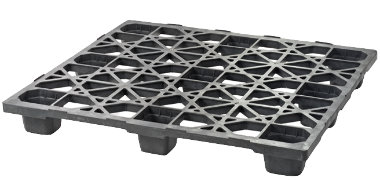


I detailed uses for the 48×40 along with nearly 40 other pallet dimensions in my previous post, Industry Standard Pallet Sizes: A Complete List. As a follow-up, I am specifically shining a light on plastic pallets and six (6) sizes commonly sold in the US.
This post is part 5 of a 10-post series on Plastic Pallets 101. (Part 4 explains capacity ratings.)
Plastic Pallet Buyer’s Guide
Every unit load and application is unique, but standards for plastic pallet sizes still exist. Many industries have set specific dimensions to safely store and transport products unique to their production and manufacturing environment. Below is a starter guide of common sizes by industry or use.

48×40
Standard US
This size is so popular, just over half of all plastic pallets listed on our website (new and used) are 48×40 in size. Loaded onto a standard 53′ dry van trailer, we can fit 30 stacks in a turned pattern.
48×32
Euro Pallet
Technically measuring 1200×800 mm, this size is often a “must have” for shipping into Europe. Many of the plastic Euro pallets we sell are designed to be lightweight to ease the cost of one-way export shipping.


48×45
Automotive
The 48×45 plastic pallet meets standards set for the North American auto industry. The 48×45 footprint is a match with the heavy-duty bulk containers used for holding auto parts.
43×43
Bulk Bags
Designed to fit Super Sacks®, the US 43×43 plastic pallet is a match for the 1100×1100 mm Asian standard for transporting big bags filled with food additives, feed, pharmaceuticals and other hard-to-handle granular materials.


45×45
CP9
The 45×45 plastic pallet is comparable to the chemical industry standard CP9, an 1140×1140 mm pallet for transporting mostly bags, boxes and drums. The dimensions are universally recognized for cubing out shipping containers.
48×48
Drum
Used primarily by the chemical industry, the 48×48 dimensions are ranked as a popular wooden pallet size in the US. Like their wood counterpart, 48×48 plastic pallets are designed to hold four 55-gallon drums without overhang.
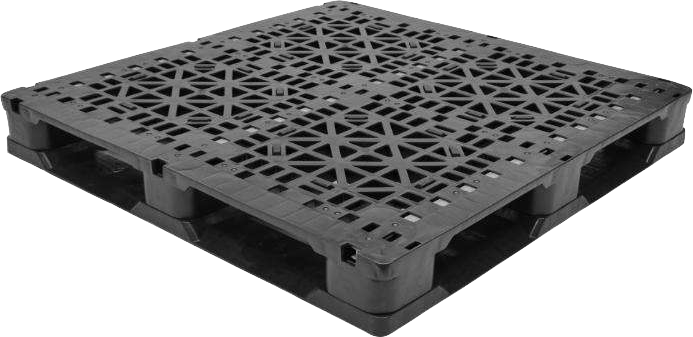
More Plastic Pallet Sizes
We’ve only just scratched the surface of available plastic pallet sizes. You’ll find more than 20 sizes of plastic pallets listed on our website including half-Euros, a variety of square options and extra large sizes like the 56×44 plastic beverage pallet. And, please note, use of specific pallet size is not limited to the industry that may have set the standard.
Need help finding a plastic pallet size for your application? Let’s connect down below for assistance from one of our plastic pallet experts.
Ideally, you want to land somewhere between a lower price-per-pallet and a fit secure enough to safely do the job.
Let’s first look at nails. They’re commonplace and often the fastener of choice. Why? Well, nails tend to flex with the wood and help maintain strength. Nails are usually cheaper. But, nails can also fail – especially if a lot of vertical force is expected on the load. We’re talking product loss or handler injury. Yikes. So… are screws better? Sometimes, yes.
3 Reasons for Choosing Screws over Nails
Sometimes a nail just isn’t the right fastener for connecting pallet components. This is especially true when the build application requires added grip or the pallet will be reused. That’s because the right fastener can actually extend the life of a pallet.
A screw is the better pallet fastener when you need:
-
Better Connection Quality
Most handbuilt pallets are nailed using pneumatic nail guns. These time-saving tools use a set air charge to fire nails into the lumber. While depth is generally good, a screw can be driven in much more skillfully for a higher-quality connection. -
Greater Withdrawal Strength
While nails and screws are available in the same length, a construction screw will have larger threads for a better grip. Screw heads are often larger than a nailhead making them less likely to get pulled through the board. Nails can work too but skip common nails in favor of helical or ring shank for better withdrawal strength. -
Increased Accuracy
Plain and simple, screws can be driven with better accuracy. But, precision comes at the price of slower production. Screw guns will expedite the build over a cordless drill and driver bit. Just make sure you first understand load conditions before putting in the time. Screws can be less effective and even break if significant horizontal shifting is expected.
The Wrong Fastener can be a Costly Mistake
Over-engineer your pallet with the wrong fastener and your price per pallet needlessly goes up. On the other hand, cheap fasteners or fast-tracked pallets can risk injury or damage loads. If you’re unsure about choosing a pallet fastener, speak with a pallet professional to identify priorities and find that perfect balance.
Do you need help deciding on a pallet fastener? Let’s connect below.
CP pallets are available in nine standard designs manufactured in metric dimensions. In this post, we’ll take a closer look at three CP pallets popular in the US and examine why these block style pallets (originally designed for the chemical industry) are becoming more common when shipping products into our global economy.
CP Pallets Provide Good Clearance
CP pallets have gained popularity in recent years for shipping internationally due to the compatibility of block pallet designs with both forklifts and pallet jacks. Some chemical pallets even share the same dimensions as two of the most widely-used pallet sizes (48″ x 40″ and 800mm x 1200mm).
Contrast chemical pallet designs to stringer style pallets. Cut out notches in the stringers help to gain 4-way entry with fork lifts, but not all pallet jacks fit under these notches. The clearance or room for a pallet jack to enter a block pallet is usually around 3 inches. A stringer pallet, on the other hand, only provides about 2 inches of clearance through the notches.

The CP1 chemical pallet is similar in size to the US 48×40 GMA pallet.
The Most Popular CP Pallets
The three CP pallet styles below are most popular because they can often replace standard US and Euro pallets. Let’s explore how you might use these CP pallets:
- CP1
1200mm x 1000mm (47.25″ x 39.38″)
Used for stacking cans, boxes and Super Sack® bulk bags. CP1 pallets have three bottom deckboards. This design is becoming popular in the United States because it is similar in size to 48 x 40 GMA pallets. Products can often be packaged in the same manner to fit either pallet. - CP3 and CP9
1140mm x 1140mm (44.88″ x 44.88″)
These square pallets are similar in size to a US 45″ x 45″ pallet. CP3 pallets and the CP9 work well for stacking and shipping drums and bulk bags. Both designs also pair well with octabins. The primary difference between the two models is the pallet base. The CP3 has 3 bottom boards and the CP9 has a perimeter bottom. Check out this new CP9 pallet made from plastic.
Using CP Pallets
With 9 different models of CP pallets available, it is very likely that a CP pallet could work for most standard-size shipments. The most readily-available designs in the US include the CP1, CP3, CP7 and CP9. When shipping internationally, it can be beneficial to ship an easy-to-use block style pallet – just in case the pallets have to be moved with a pallet jack. Working closely with your pallet supplier can assist in choosing the right CP model to fit your packaging needs.
Beyond equipment compatibility, you must consider ISPM-15 requirements if you are exporting wood packaging. CP pallets are often made with dry pine (and for good reason). The heating process for removing moisture from pine exceeds heat treatment (HT) requirements set by IPPC. That said, always seek advice on current regulations before exporting – even if you see a manufacturer’s HT Stamp clearly stenciled on both sides of CP pallets.
Will CP Pallets work for you?
So now you know that CP pallets are not restricted to the chemical industry. Give it some thought. How could CP pallets work for your products?
Do you package products in some of the same sizes as the CP pallets? Let’s connect. Tell us about your product and current pallet below and we’ll help you choose the best CP pallet for your application.
How popular? The 48×40 accounts for approximately 30% of all wooden pallets produced each year.
The 48×40 standard was set by the Grocery Manufacturers Association (GMA) more than forty years ago. For this reason, you may hear it called a GMA pallet. But, not all 48×40 pallets are designed to GMA specs nor are they all used in the grocery industry. Interestingly, that’s true of most any “industry standard” pallet. Even though a pallet may have originally been standardized for a specific trade, its use is often not exclusive to that industry alone.
Most Popular US Pallet Sizes
You’ll notice many of the most popular sizes on this list are square pallets or nearly square. That’s simply physics. A square base can help to prevent load tipping. Below are ways you’ll most often see these popular pallet sizes used:
- 48×40 in Grocery and general warehouse
- 42×42 in Telecom; technical coatings and paint
- 48×48 in Fits four 55 gallon drums without overhang
- 40×48 in Military; cement bags and blocks
- 48×42 in Packaged chemicals and beverages
- 40×40 in Dairy, designed to fit stacked milk crates
- 48×45 in Automotive, meets AIAG specs
- 44×44 in Chemical drums and FIBC bulk bags
- 36×36 in Beverage, specifically Coke and Pepsi trucks
- 48×36 in Roofing and shingles; paper; beverage
Pallet Sizes for Exporting
The 1200×800 Euro pallet (you may see it labeled as EUR, EUR1 or EPAL) is Europe’s market leader by a landslide. Many European conveyor systems and other handling equipment cannot accept larger pallets. Ship in the wrong size and you may get hit with disposal and repacking fees. Many metric dimension pallets in use around Europe, Asia and other foreign locations are similar in dimensions to popular US pallets bringing us close to global pallet size standardization:
- 1200×800 mm (US 48×32) Most popular; designed to fit European trucks and machinery
- 1200×1000 mm (US 48×40) Computer warehouses and distribution centers
- 1140×1140 mm (US 45×45) Maximizes freight density for shipping containers
- 1100×1100 mm (US 43×43) Granular chemicals in bulk bags
- 1190×1135 mm (US 47×45) Export alternative to US automotive standard

Beverage pallets like this one perfectly fit 4-case stacks of canned sodas.
Retail and Beverage Pallets
Most anything you drink from an aluminum can, plastic or glass bottle was probably sitting on a beverage pallet (including the popular 36×36 pallet listed above). At the store, you may find your favorite soda pop stacked on a point-of-purchase or retail pallet placed up front or at the end of an aisle. The brewing industry transports beer kegs on larger bulk beverage pallets.
- 32×24 in Known as a Half Euro measuring 800×600 mm
- 36×48 in Used during manufacturing and warehousing of consumer beverages
- 37×32 in Popular with beer distributors because the 32″ side easily fits delivery trucks
- 37×37 in This beverage pallet holds aluminum cans, plastic and glass bottles
- 40×24 in This retail pallet is a great fit for end-cap displays
- 48×32 in Big breweries like the 32″ side for getting through commercial delivery doors
- 48×24 in This display pallet size is used for small order shipments and in-store displays
- 48×20 in This half pallet is half the width of a US standard 48×40
- 55×43 in Used for for shipping beverages overseas
- 56×44 in Bulk beverage or bulk can pallet for transporting liquids

CP pallets are manufactured from wood but plastic chemical pallets are also common. The wooden CP3 pallets shown here are designed to be used with drums, bulk bags and octabins.
Chemical Pallets
You will often hear chemical pallets called by the short-cut name, CP pallets. There are nine standard designs manufactured in metric dimensions. Each pallet is stamped with a designation from CP-1 thru CP-9. The specifications were set by European chemical industries but are suitable for many other uses. In the US, chemicals are commonly moved and stored in drums and bags using the popular 48×48 and 44×44 pallets mentioned in the first list.
- CP1 1000×1200 mm Sacks, cardboard boxes, cans
- CP2 800×1200 mm Cardboard boxes, drums, cans
- CP3 1140×1140 mm Drums, FIBC, octabins
- CP4 1100×1300 mm Sacks
- CP5 780×1140 mm Cardboard boxes
- CP6 1200×1000 mm Sacks
- CP7 1300×1100 mm Sacks
- CP8 1140×1140 mm Octabins with bottom discharge
- CP9 1140×1140 mm Drums, FIBC, octabins

Despite the popular use of industry standard pallet sizes, there are almost as many custom wooden pallets in circulation.
Other Pallet Sizes
The pallet sizes shown in the “most popular” list above make up about 60% of the US market. Every other size in this post plus hundreds of others make up the remaining 40%. The rare standards and a large number of custom wooden pallets in circulation show us that close to half of pallets in use are not a standard size. Some of these include:
- 1200×1100 mm (US 48×44) Paper industry for supporting heavy paper spools
- 1100×900 mm (US 43×36) Export
- 60×60 in Speciality, bulk textiles: surface area of 60 x 60 plastic pallets fit rolled foam (5′ in diameter)
- 1000×1000 mm Square 39×39 plastic pallets popular in Asia for exporting bulk bag loads
Were any standard pallet sizes from your industry missed? Let’s connect. Let me know below and I’ll update the pallet list to make it as complete as possible.
Recycled wooden pallets or remanufactured? It’s a question that comes up often. Before we get into which pallet is better for your packaging needs, let’s sort out the definitions of recycled vs remanufactured.
Defining Recycled vs Remanufactured
Buying wooden pallets starts with understanding the industry lingo. If you’re just beginning your search, you’re learning that not everyone speaks the same language. Worse, many of the terms sound confusingly similar. Below are the most common interpretations:
Recycled Pallets
Recycled wooden pallets are repaired quickly without complete deconstruction. The mending results in a pallet similar to the original design. Recycled pallets may also be called:
- Repaired Pallets
- Refurbished Pallets
- Reconditioned Pallets
Remanufactured Pallets
Also called reman pallets, these are completely rebuilt using dismantled boards reclaimed from unrepairable wooden pallets. A variation of reman pallets are built using a mix of old and new materials. Alternate names for both varieties of remanufactured pallets include:
- Rebuilt Pallets
- Hybrid Pallets
- Combo Pallets
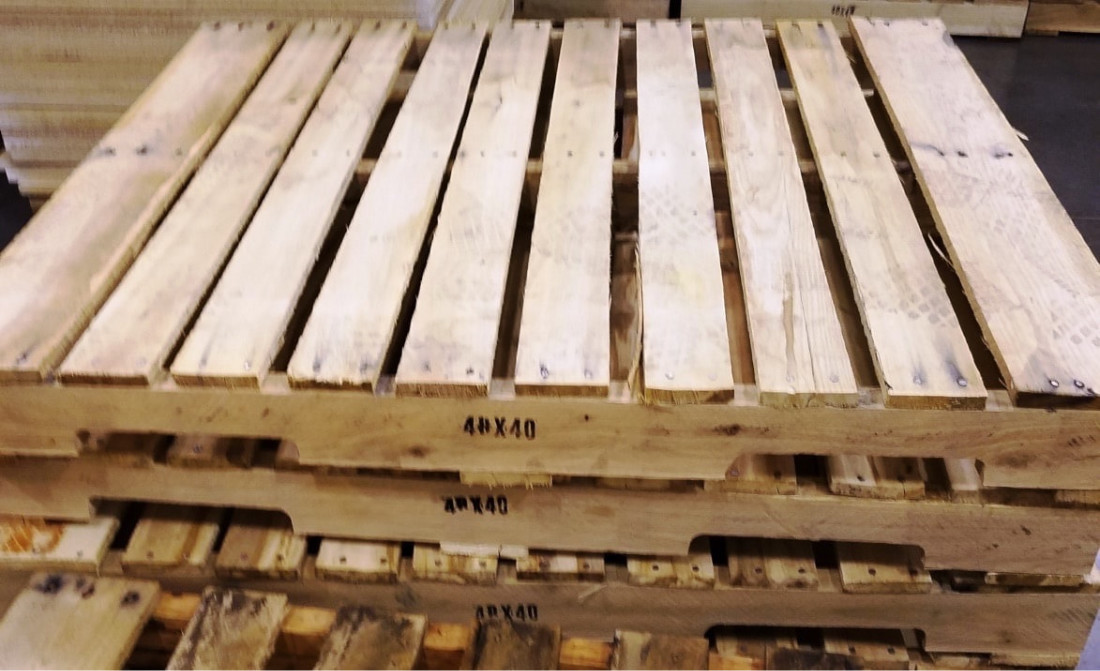
Custom spacing between deck boards is one benefit of choosing remanufactured pallets.
Cheap vs Flexibility
Recycled and remanufactured wooden pallets each have their own advantages. Recycled pallets tend to be cheaper. Reman pallets offer design flexibility. Your unique packaging requirements will determine which one is best.
Choose Recycled Pallets (Cheap)
Recycled pallets are easiest to find in industry standard configurations and sizes. They are typically sorted by size and grade. Choose recycled pallets if your load safely fits within the guidelines for an industry-specific pallet. Common examples of recycled pallets include:
- GMA Pallets
- EPAL Pallets
- CP1 Chemical Pallets
- CP3 Chemical Pallets
Choose Remanufactured Pallets (Flexible)
If your load exceeds the weight or size guidelines of a more readily-available pallet, choose remanufactured. Reman pallets can be custom built to adjust the spacing or length of deckboards. Have a lighter load? Ask about money-saving designs engineered to use less lumber. The point is that reman offers almost endless opportunities like these:
- 48×40 with Special Top Deck Spacing
- 48×31 Built Only with Reclaimed Wood
- 72×36 Built using New Stringers and Used Deckboards
Your Most Sustainable Choice in Pallets
Now that you know what we mean by recycled and reman pallets, it shouldn’t come as a surprise that most wooden pallets in circulation are not new. Repairing and rebuilding is a smart choice for saving money and reducing waste. While heavily-regulated industries might not be a good fit, most pallet users can benefit from using recycled and remanufactured pallets.
Still deciding between recycled and remanufactured pallets? Let’s connect. Tell us about your sustainability goals or ask questions below.
Many decades ago, lumber purchased from a sawmill physically matched the common dimensions we use today. So why does that pine or spruce 2×4 from your local lumber yard now come up short? The short answer is modern surfacing and shrinkage.
Looking Beyond Lumber Shrinkage
The true answer lies a little deeper than just modern processing equipment and shrinkage of lumber. Depending on the species and grade of the lumber the boards will either go into a drying process or be sold as green lumber where the moisture content isn’t altered.
Pine and many softwoods which allow for quick drying times are commonly dried for dimensional lumber. Hardwood species take longer to dry due to higher densities and are designated for furniture or flooring markets. The rough sawing dimension required to cut depends on what market the lumber will be finally processed for.
When the logs are first sawn, the boards are cut with the anticipation of needing to dry and be machined into their final dimensions. Only lower grade lumber will not be dried. More dense wood species such as Oak would be first cut at much larger dimensions than lower density woods such as Pine. Hardwood lumber is dried for aesthetic markets where the lumber is graded on size of defects and overall appearance. Pine lumber is graded on size of defects but more focused on being structurally strong when used in building construction.
Hardwood Lumber (Oak)
Oak is often first cut 1″ thicker over what the final dimension would be cut. Hardwood lumber that makes grade for flooring or furniture markets will be slowly dried. A typical moisture content for hardwood species would be dried to or below 10% moisture content. Dense wood must be dried slowly to avoid creating defects such as warping, bowing or checking. After the lumber has been dried, it will then be planed/surfaced and edged to its final dimension. This allows for mills to cut out defects such as knots, warping, etc. so the lumber grade is maximized. Hardwood lumber is more commonly bought and sold as 4/4 for 1″ thick and every 1/4″ upward.
Hardwood Summary
- Originally sawn 1″ thicker than what it will be finally sold as
- Dried slowly to avoid creating defects reaching around 10% MC
- Drying times take 25-35 days
- Dried to be sold into flooring and furniture markets for aesthetic appearance
Softwood Lumber (Pine)
Pine would normally be sawn closer to 1/2″ thicker than its final dimension. This is why pine lumber is commonly called a 2×4 when they actually measure 1.5 x 3.5. Pine is a less dense wood species and it allows for quick drying times. Pine designated for building components would be dried to 19% or below which is the standard for building products. The lumber will be dried at the original dimension of full 2″ x 4″ and after drying the boards will be surfaced with a planer head and trimmed down to 1.5″ x 3.5″.
Softwood Summary
- Originally sawn about 1/2″ thicker than final dimensions
- Dried quickly in high volume drying kilns reaching 19% MC
- Drying times take 20-30 hours
- Dried to be sold into structural framing applications (not appearance graded)
Over time we’ve come to accept these nominal (approximate) dimensions as standard. But there’s still a catch. Shrinkage can be highly variable. This makes it very difficult to manage and regulate dimensional accuracy.
Rules for Calculating Dimensions
So now you know that 1×3, 2×4 and 4×8 are really just names or nominal dimensions. But… it gets even more complicated. Dimensions change based on the width or the thickness. Here are the general “rules” for calculating softwood dimensions:
Nominal vs Actual Dimension Rules
| Nominal Dimension | Actual Size |
|---|---|
| Less than 2 inches | Reduce by 1/4 inch |
| Less than 8 inches | Reduce by 1/2 inch |
| 8 inches or greater | Reduce by 3/4 inch |
Dimensional Lumber
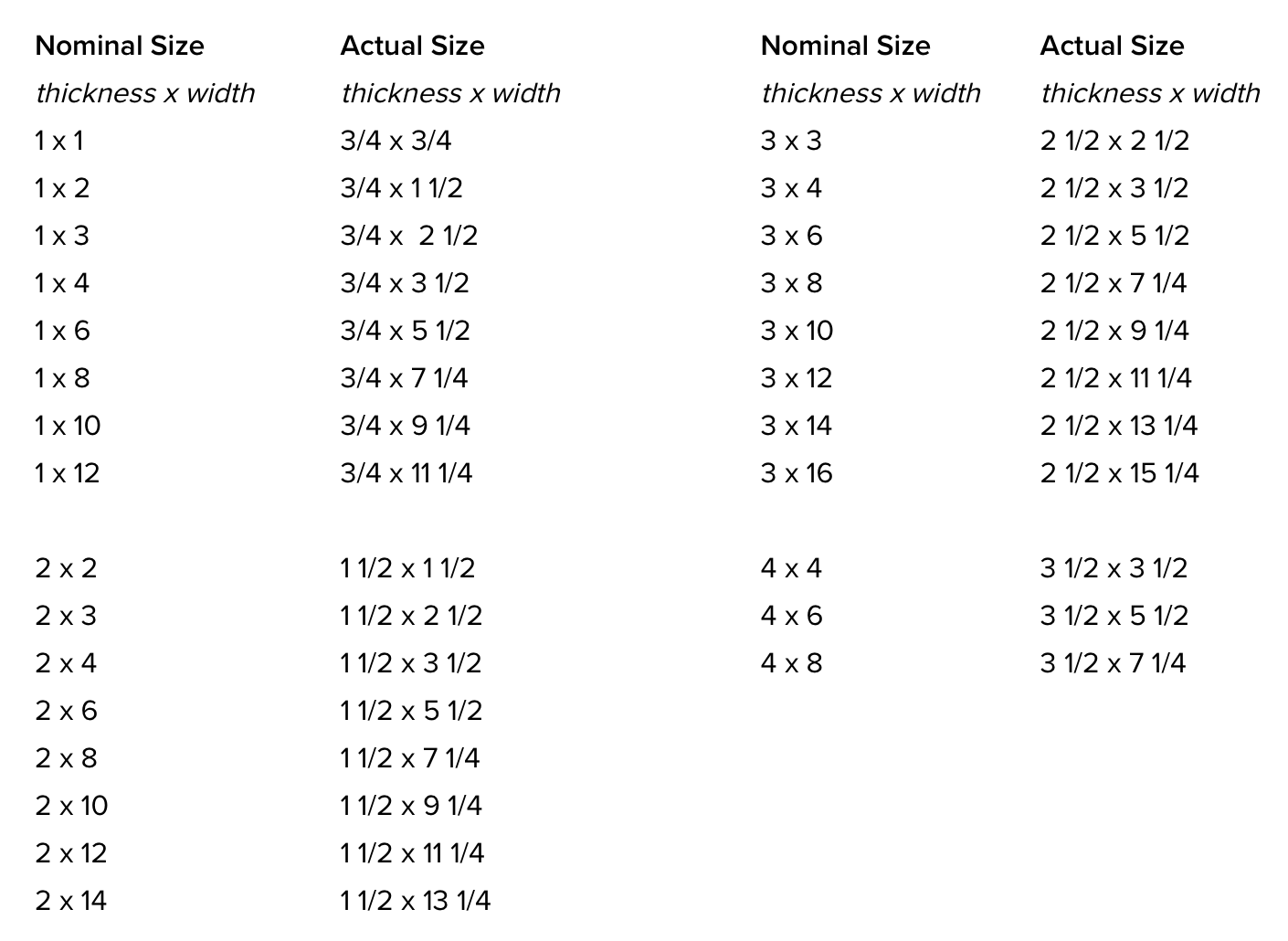
Softwoods (pine, spruce, fir, etc.) are generally known as framing or dimensional lumber. This wood is commonly used for framing walls and floors in our homes and regularly used for building wooden crates and pallets. Since no one likes unexpected dimensional errors, the handy chart below outlines the changes in dimensions you can expect:
Dimensional vs Actual Lumber Chart for Dried Softwoods
Regulating Lumber Dimensions
The US Department of Commerce standardized softwood dimensions for green and finished lumber back in 1969.
Today, regulating dimensional accuracy in the US falls under the responsibility of the National Institute of Standards and Technology (NIST). The current standards are published by the government in a document titled the American Softwood Lumber Standard (PS 20). The current version is labeled the Voluntary Product Standard PS 20-20 .
Why is regulation so difficult?
State and local inspectors spot check lumber dimensions at mills and retail locations but determining if softwood boards are within limits is complicated. Here’s why:
-
Shrinkage
Green lumber has higher moisture content. As the wood dries (either in an oven or air dried) the dimensions reduce. Depending on wood species – and specifically wood grain direction – shrinkage can range from 2% to 15%. This equals anywhere from 0.012″ to 0.6″ for a 4 inch board. -
Surfacing
Boards with smooth sides are said to have a dressed surface. The process of smoothing out board surfaces further reduces the original width or thickness. Dimensional lumber is commonly labeled S4S. The designation stands for “surfaced 4 sides“. -
Inconsistent Testing
Inspectors do not have nationally agreed-upon testing procedures. Everything from an individual inspector’s sampling protocol to the device used for measuring can muddy the results. That’s about to change.
If you’re wondering about hardwoods, thickness measurements are slightly different, but most hardwood widths follow the softwood standard. As an example, a 6″ hardwood board is actually 5.5″.
New Testing Procedures Under Review
The Office of Weights and Measures (OWM) at the NIST has been working with the American Lumber Standards Committee (ALSC) since 2016 to develop new testing procedures for dimensional accuracy. The last update was in 2020. The next big step in moving the new procedures forward is a five-year revised standard (PS 20-25) currently under review.
Have you ever wondered about the impact of lumber’s dimensional accuracy on wooden pallets and crates? Have your own wrong-size lumber story you need help solving? Send your details down below and let’s connect.
A former study done by the USDA and Virginia Tech determined that SYP made up 18.9% of all woods used while oak made up 17.1% (by volume). Both oak and SYP actually contain several species that make up the woods classification which is based on the density of the wood.
Why Southern Yellow Pine?
Pine lumber is commonly used in pallets due to its availability and low cost. It also can be kiln dried and provides a clean product needed for many applications such as pharmaceutical or food-related industries.
Why Oak?
Oak is commonly used due to its strength and availability. While originally cut for more profitable markets, leftover oak lumber that doesn’t make a high enough grade for furniture is then used in pallet production. Oak is also one of the stronger hardwood species. Because of this strength, many customers have found that by using hardwood lumber, they can get by with less boards or thinner components on their pallets.
The current trend by many wooden pallet manufacturers is to not separate out pallet material by species, but rather by hardwood vs softwood.
Are you curious which type of wood species would be best for your pallets? Let’s connect below for help determining if hardwood or softwood is best for you.