

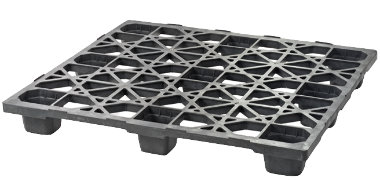


When you’re not using these cups at home, you probably store them in a way that saves space in the cupboard, right? The shape of most coffee cups lets one cup rest inside another to take advantage of vertical storage space. It’s the same with plastic nestable pallets. They’re just a lot more stable.
What is a Nestable Pallet?
A plastic nestable pallet is designed to allow each pallet to fit snugly on top of one another in tall bundles when not in use. Most designs use 9 hollow feet or legs (think nine jumbo coffee cups) to achieve this “nesting” effect.
Of course, there are design exceptions. Leg counts can vary (higher or lower depending on pallet dimensions) and some pallets use a low profile bottom deck to achieve similar space-savings. Clearly, nesting saves space, but why else is this design valuable?
3 Ways Nestable Pallets Save Money
-
Save on Storage Costs
Warehouse space at a premium? Plastic nestable pallets fit many more pallets per stack (as many as 70+ per stack). Less space on the floor equals savings. -
Save on Freight Costs
Nestables save two ways here. First, nesting maximizes savings when you calculate the purchase of full truckloads on a cost-per-pallet basis. Second, the lightweight nature of nestable pallets reduces airfreight export costs. -
Save on Purchase Price
Remember those hollow legs? Nestable pallets (especially open deck styles) inherently use less raw materials to manufacture. Less material (plus those reduced storage and transport costs) translates to a lower price tag.
Nestable Pallet Defined
Well, there you have it. You now know how to define a nestable pallet. And, you understand how these cleverly designed plastic pallets with 9 feet can save money. Great job. You earned yourself a coffee break.
Will nestable pallets work for your application? Let’s connect to find out. Tell us about your load and requirements below.
That’s because 48×48 drum pallets can easily hold four 55 gallon drums without hanging over.
Everything from caustic chemicals to the raw ingredients used in the food we eat moves in 55 gallon drums. So, it should come as no surprise that the 48×48 drum pallet is the second most popular pallet size in the US. Popular? Yes. The only solution? Far from it.
Pallet Sizes for 55 Gallon Drums
It doesn’t matter if your drums are holding orange juice concentrate or automotive lubricants, measurements matter. Make sure you’re paying attention to those outside dimensions. Also, there’s a good chance there will be spills. Choose easy-to-clean plastic drum pallets for long life in these sizes:
-
48×48 Plastic Drum Pallet
Specifically designed to hold four 55-gallon drums without overhang. Available with optional perimeter tabs to help prevent drums from shifting. -
CP9 Plastic Pallet
CP9 plastic chemical pallets are 1140×1140 mm (or 45×45 inches) and are universally recognized as the standard for cubing out shipping containers when exporting drums. -
48×45 Drum Pallet
Interrupted lips dotted along the perimeter of this plastic pallet contain four 55-gallon drums and allow shippers to double-stack pallets. -
44×44 Chemical Drum Pallet
Less popular than the 48″ square pallet, these pallets can be harder to source. Extend your search to used 44×44 drum pallets and the equivalent 1140×1140 metric size. -
48×40 3-Drum Pallet
When your storage or transport space requirements dictate your pallet size, 48×40 plastic pallets can handle three 55-gallon drums.
Barrels and Other Drum Sizes
So far we have only talked about 55 gallon drums, but many sizes exist. There are 30 gallon wooden barrels used for warehousing beers and spirits. Wine fermented and aged in stainless steel drums include 16 and 25 gallon sizes in addition to 55 gallons. No matter what size barrel or drum you use, there are pallets capable of storing, stacking and transporting your specific drum size. There are even opportunities to swap your barrel racks for pallets to save storage space.
And, finally, a little schooling. Did you know that the 55-gallon drum we know so well in the US is actually called a 44-gallon drum in other parts of the world. Why the difference? The drum is actually 200 liters in size. A US conversion rounds to 55 gallons, but the conversion to imperial gallons (used in places like the UK and Canada) makes it 44 gallons. Exact capacities can vary depending on construction. Interesting, right?
Need help figuring out the best plastic pallet for your drums? Let’s connect. Tell us about your product and drum storage below.
Sure, we can say most plastic pallet designs are strong. They’re resistant to moisture and less likely to harbor smells or mold. Those are generally fine specs for nearly all applications. But in stricter circumstances, we sometimes need to consider how the pallet is engineered. Let’s find out why and when that matters.
Advantages of One-Piece Plastic Pallets
We’ve already noted some worthy advantages of plastic pallets. Add in one-piece designs and you’re on your way to conquering your most pressing pallet requirements. What is a one-piece plastic pallet? A solid body pallet molded from a single piece of material with no welds. One-piece designs help to:
-
Avoid Infestations
Are you an exporter? All plastic pallets are exempt from ISPM-15. Having said that, two-piece stackable pallets (and even some nestables) may have voids or pockets that are attractive to bugs or other living organisms. A one-piece pallet has no voids so there’s ZERO chance any of those troublesome pests are gonna hop along for the ride. -
Avoid Contamination
Calling all pharmaceutical and cleanroom manufacturers. One-piece plastic pallets made from non-porous materials help to maintain safety protocols in sterile environments. Free from seams, one-piece designs are easy to clean and eliminate places for water and contaminants to hide. Plastic pallets also remain stable to meet extremes for most temperature and humidity requirements. -
Avoid Breakage
Heavy loads got you down? Nestable pallets with snap-on bottoms offer a less expensive alternative to heavier full-perimeter or 3-runner plastic pallets. Here’s the catch – the lighter design may make these pallets vulnerable to damage the more they are moved. One piece pallets have “less moving parts” so less can go wrong as they get more use. Consider one-piece pallets for unsupported racking and floor stacking.
One-Piece Plastic Pallets to the Rescue
Challenging environments can really put your pallet to the test. We’ve seen it all from bugs and mold concerns to protecting the safety of people and loads. Problems found anywhere in your supply chain including manufacturing, warehousing or transporting can be solved with the right pallet. In some situations, the answer to your troubles may be a one-piece plastic pallet design.
Can your pallet challenges be solved with a one-piece design? Let’s connect to find out. Share your application details below.
Don’t worry. You haven’t done anything wrong. Not yet, at least.
I know, I know. You’re in a hurry and don’t really want to talk about hygiene and plastic pallets, but hear me out. Choosing the wrong pallet could wind up costing you – in time, money, or something worse.
What are Hygienic Plastic Pallets?
If you’re reading this, someone has probably asked you to source hygienic plastic pallets. What does that even mean? To Tell the Truth (see what I did there?) I don’t know. Well, I don’t know until we talk.
You see, hygienic has no official meaning. It’s similar to finding “natural flavors” stamped on that bag of chips you may have snacked on earlier today. Yeah, me too. Point is, you don’t know how (or even if) your definition of hygienic benefits the application unless you verify it aligns with your goals. When it comes to pallets, hygienic is often associated with higher cost, but not always. I’ll explain.
Here are three common goals for choosing hygienic plastic pallets:
-
It Needs to be Easy to Clean
Do you like to keep things neat and tidy? Ditto. That’s why I like plastic pallets. It doesn’t matter if the top deck is open or closed, almost every plastic pallet can be hosed down to wash away everything from dust to contaminants. Nothing fancy needed here. Just plastic. Boom. I just saved you a ton of money if your only hygiene goal is to maintain an inventory of clean pallets. -
It Needs to Meet FDA or USDA Requirements
Even if you need to meet government sanitation requirements, say from the Food Safety Modernization Act (FSMA), you may still only need a “regular” plastic pallet. Some used plastic pallets can even meet FDA guidelines including: easy-to-clean, non-toxic and being in good repair. See, I saved you money again. If you handle unpackaged food or medications, your hygienic requirements are stricter and likely include FDA plastic pallets made from virgin materials. -
It Needs to be Sterile
Now we’re talking serious hygiene. You fall into this stringent category if your requirements include terms like cleanroom, white rooms, contaminant-free, anti-microbial or heat sterilization. You may see these called pharmaceutical plastic pallets, NSF-certified or yes, even hygienic plastic pallets. To maintain safety protocols, these pallets should be one-piece and have smooth, non-porous surfaces made from polyethylene and virgin raw materials capable of standing up to the rigors of sterile drug and other manufacturing environments.
Which Hygienic Plastic Pallet is Right for you?
Now you understand why it is important to talk with a pallet professional when selecting the right hygienic plastic pallet. In addition to the goals above, there are many more requirements to think about. For example, vaccines. Not only are we talking clean, but many vaccines require plastic freezer pallets capable of handling near freezing or sub-zero temps. And, many vaccines will need to ship on Euro plastic pallets. On the other side of the temperature spectrum, some Pharma applications need FM approved fire retardant plastic pallets that meet decaBDE-free standards. What additional environmental requirements does your application have?
I’ve done all the talking and now it is your turn. Let’s connect to talk about your environment and goals. We’ll match you with the right hygienic plastic pallet for the job.
Plastic pallets are generally engineered for durability. Even the ones manufactured for one-way shipping can often survive multiple trips. The staying power of plastic has greatly increased circulation numbers of used plastic pallets creating an interesting opportunity.
Sell or Buy Used Plastic Pallets
When one company finishes with a plastic pallet, another is ready to put it to use. That means the used pallet market makes it easy for companies to either make or save money.
Here is why more companies are choosing used plastic pallets:
-
A Better Pallet at a Lower Price
Instead of buying a brand new “low-end” pallet, companies can get a higher-quality pallet in used condition for better reliability and performance. -
Meets LTL Requirements
When a truckload is too many, companies can buy just a stack or two of used plastic pallets for one-time or low-volume applications. -
Supports Sustainability Efforts
The cost savings and environmental benefits of buying a multi-trip used plastic pallet fit hand-in-hand with sustainability programs. -
Resale Value
If requirements change or if a supply chain partner sends in pallets that are not compatible, stacks of unwanted plastic pallets can often be sold for cash. -
Virtually Maintenance-Free
Plastic resists mold and bacteria growth. A reliable broker will inspect used plastic pallets for damage and wash them before offering them for sale. -
Avoids ISPM-15 Regulations
Even if a plastic pallet has made a roundtrip from the US to Asia and back, it can still be exported again without the risk of costly border holdups. -
Price Stability
While fluctuations in resin availability can impact new pallet prices, the used plastic market is typically immune to increases in raw material costs.
Used Plastic Pallets are not for Everyone
Companies that choose used plastic pallets must have flexibility. A top reason is that there are few guarantees when it comes to availability. Sources can dry up. Some pallets that enter the used market may be a one-time only opportunity. Plus, loads of the same used pallet can differ in appearance (including variations in design or color).
Are used plastic pallets right for your company? Let’s connect. Tell us the reasons most important to your pallet buying decision below.
Air freight is the creme de la creme of all shipping methods and comes with a hefty price tag. But, can choosing the right pallet for air shipments really help “lighten the load”? Yes. Yes it can.
Choose the Right Air Freight Pallet
Air freight can be expensive. But cost-conscious businesses with lean inventory often depend on air freight (instead of ocean) to move product in a timely, more predictable manner. So how can these businesses optimize air freight cost? Easy. Consider these money-saving air freight tips:
-
Follow Industry Standards
By industry standards, I mean shipping on an ISPM-15 exempt pallet. All plastic pallets are inherently compliant with export regulations so they eliminate the need for stamping and documentation. This makes exporting hassle-free and lessens the chance for freight delays. -
Go Light
You know how you get charged for that extra suitcase when you fly on a trip? Well, that’s what airlines call chargeable weight and it applies to cargo too. It is calculated using weight and dimensions. The lightweight nature of plastic pallets makes most of them export friendly. So choosing a 15 lb plastic pallet over a 35-40 lb pallet is really going to save you some money. -
Think Nestable
Nestable pallets tend to be lighter in weight and cost less. This is especially important to consider when the pallets are shipping one-way and are not expected to return. When not in use, nestable plastic pallets take up less space to save money in storage and transport costs. -
Add Optional Runners
Need more support? Some loads require more secure stacking capabilities when shipping via air cargo. A popular option for creating a flat and safe surface is to snap on runners to the bottom of nestable pallets to make stackable plastic pallets. This still keeps the pallet weight and price down but adds stacking and racking capabilities. -
Get Size Advice
Size matters. Plastic pallets have consistent and precise sizing and weights to make calculating your loads easier. Not only that, they come in many sizes to work with your application. The right size can prevent cargo damage and save money. -
Ask About Used
New isn’t always better. There is a huge selection of used plastic pallets that are ideal for export. Used pallets are structurally sound and typically have only some minor cosmetic damage. Best of all, they cost less.
Reduce Headaches and Save Money
Shipping air freight can be an expensive headache. Using the wrong pallet for export could be costing more than you realize. Getting expert advice for choosing the right plastic pallet really can help make the process easier and cheaper.
Have a question about choosing the best pallet for your air freight application? Let’s connect. Tell us the reasons most important to your pallet exporting below.
Learn the easy way for getting top dollar when selling your used pallets. Plus, earn extra points towards your sustainability goals. When you sell your used pallets, they get another turn and avoid a trip to the landfill.
Used Pallets in Demand
Our lesson starts here. The loading dock area of your production facility is running out of space. Your suppliers are sending you raw materials on plastic pallets. Your workers have been stacking those pallets against the walls day after day and now there isn’t an inch to spare. Sound familiar?
Here’s the good part. Those pallets you’re tripping over could be in demand. The trick is finding out who wants them.
Here’s how to get Top Dollar:
-
Make sure the pallets are yours to sell
Got proof they’re yours to sell? Excellent. A little history helps too. Remember… never sell pallets if you are unsure of ownership rights. -
Try to stack pallets by consistency in size and quality
Shoot for pallets that are the same size and in good working condition. A little dirt or dust along with some small aesthetic damage can be OK but there should be no significant fractures or broken, dangling pieces. Ask yourself, “Would I put my product on that pallet?” -
Take photos detailing marks and condition
Good photos are the next best thing to an on-site inspection. Take photos of the pallet top and bottom. Get close-ups of part numbers and other markings. Also snap photos of the stacks and storage location.
Start Cashing in
Now you know the secret. Accurate details help you to get the best price. Stop stacking and start cashing in. Measure, take photos and fill out our Sell Your Used Pallets form. Oh yeah, here’s a bonus tip… if you seem to collect the same plastic pallets on a regular schedule, your used pallets just might be extra attractive to buyers.
Would your company like to crate products but there’s simply not enough space in your shipping area? If space is not the issue, is nailing or screwing crates together creating hassles and slowing down your workers? Would you like to save money? Allow me to introduce you to Nelson Clip Crates.
Save Time and Space with Nelson Clip Crates
-
No Special Tools
All you need to assemble these crates are metal clips and a small amount of hand-applied pressure. A rubber mallet can make the job easier. -
Fast and Easy
Nelson Clip Crates utilize specially manufactured crate components that can easily be assembled on site by anyone. -
Everything is Included
Nelson Clip Crates are packaged into kits that come with all the necessary elements for assembly.

No more nailing or screwing. Just attach durable metal clips with hand pressure or a rubber mallet.
Your Choice of Material
Nelson Clip Crates can be made in your choice of materials including:
- Lumber
- Plywood
- OSB (Oriented Strand Board)
- MDF (Medium Density Fiber Board)
Customized to your Shipping and Size Requirements
-
Shipping
Nelson Clip Crates can be designed to be reusable or for one-way shipments. Clip crates disassemble easily for reuse. Exporting? We can produce the crates in compliance with ISPM-15 standards for international trade. -
Standard and Custom Sizes
These easy-to-assemble crates can be adjusted to fit almost any size requirement. Current Nelson Clip Crates range in size from 2 feet to over 10 feet in length. -
Interior Options
Custom interior dunnage including shelves, trays and gussets can be designed to fit inside the Nelson Clip Crates. Custom options are included in the kits shipped to you.
Do Nelson Clip Crates Sound like your Perfect Solution?
Do you want to build custom crates faster and in less space than traditional crating solutions? Would you like to hear about a money-saving Nelson Clip Crate case study? Let’s connect below.
Plastic pallets have increased in popularity over the past decades. In a recent study, 43% of companies using pallets include plastic. Plastic is being used in just about every industry including Pharmaceutical, Medical, Electronic, Chemical, Rubber, Food and Food Additives just to name a few.
If you can’t use all plastic pallets coming into your plant, you’re probably wondering how you can you get rid of them. I got you covered.
Plastic Pallets Piling Up?
If you are like most companies, your pallets are stacked in corners or stored in empty trailers until someone figures out how to get rid of them. Unlike wood pallets, you cannot burn them or grind them into mulch. Getting rid of them starts to become a big challenge. Landfills are not an option either so what do you do?
Here are my top 3 ways to deal with used plastic pallets:
-
Use Plastic Pallets Internally
Search high and low for ways to use them internally. Can you ship finished product out on them? Can another department or facility use them as a “captive” pallet? In both these cases, you are extending the life of these pallets without sacrificing the environment or your bottom line. -
Find a Used Plastic Pallet Buyer
Find a source that can continuously take the used pallets out of your way. Used plastic pallet experts like Nelson Company specialize in finding qualified end users for used plastic pallets. Buyers are willing to pay for used plastic pallets that have extended lifecycles. One company gets a trip or two out of a plastic pallet and then Nelson Company helps another company use it again (and again). It’s a WIN-WIN for all involved. -
Get Paid for Scrap
If your quantities are varied or your used plastic pallets are not functional due to damage, buyers are usually not interested. In this case, start searching for a local plastic scrap company. There are plenty of recyclers that are willing to pay you for your scrap plastic.
Help the Environment and Get Paid
Now you know getting rid of your used plastic pallets does not have to be a daunting task. You can help your bottom line by reusing them in-house, reselling them as used pallets, or selling them for plastic scrap. No matter your choice, you’re doing your part by keeping plastic pallets out of landfills.
Want to know if those unsightly stacks of plastic pallets at your company are worth something? Let’s connect. Tell us about your stacks below or complete our Sell Your Pallets web form.