

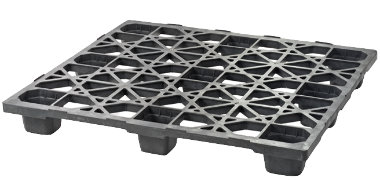


Now, that’s not to say companies exclusively use wood. 43% of survey respondents use plastic and another 26% reported using wood composite, for example. But, clearly, pallets made from wood still hold a commanding lead for transporting goods. A quick note… originally published in 2022, some content in this post has been updated to reflect the latest results.
Study Conclusions
The 2022 Pallet Market Evaluation was conducted by Peerless Research Group on behalf of Modern Materials Handling. We’re highlighting the results of three additional survey questions:
-
New vs Used
Results for 2022 showed 72% of respondents purchased used wood pallets while 54% went with new. In this same section, only 8% checked the box for pallet pooling. Pooling is continuing a downward trend from its high of 24% in 2020. -
Procuring Used Pallets
Uh oh… some not-so-good experiences for 2022. More than half (56%) say they had trouble getting their hands on used wooden pallets. Not surprisingly, 40% also noted that prices are up. And, short supply drove 44% to report the quality of used pallets has been worse. -
Exporting
When asked what companies do differently when shipping internationally, 49% said they have their wooden pallets treated for export. Some use the wood pallets they already own (24%) while 19% don’t make any changes from domestic shipments. Another 19% reported making the switch to plastic, corrugated, pressed wood or metal (alternatives to meeting ISPM-15 export regulations).
Room for Improvement
While the study results were mostly consistent with our own experiences, we couldn’t help but notice missed opportunities for survey respondents to save money.
A whopping 62% said they were not interested in getting help to better understand optimal pallet and transport packaging combinations. Another 27% said they were only somewhat interested. When it came to saving money with pallet retrieval and recovery systems, 58% reported not being interested and 16% had not even heard of it.
Being open to change has saved our customers millions. Everything from transforming over-engineered legacy pallets to optimizing (or returning) packaging has improved the bottom line – significantly.
Are you ready to answer “very interested” for learning how to improve your pallet system? Let’s connect. Tell us how you use pallets with your system or post your questions below.
Essential to supply chains, these unassuming platforms are busy transporting everything from your morning coffee to the high-tech components helping to lift rockets into space.
Roughly 90% of US pallets are made from wood. That’s according to the latest Annual Pallet Report published by Modern Materials Handling. With so many wooden pallets in circulation, you may be asking if wooden pallets are really a sustainable choice. Yes, yes they are.
Environmental Product Declaration (EPD)
While most attention in distribution packaging has been (rightly) focused on the chaos ushered in by COVID-19, there was a quiet celebration for wooden pallets in the United States:
In July 2020, UL certified the “Industry-Average Wooden Pallet EPD”
An EPD (short for Environmental Product Declaration) is a huge achievement for the US wooden pallet. For starters, an EPD has never before been granted for packaging material. More importantly, the declaration gives wooden pallets the distinction of being leaders in environmental stewardship. The industry-average wooden pallet EPD includes:
- Hardwood and softwood
- OSB and plywood
- Block and stringer designs
- Light and heavy duty
- New and recycled
It’s all about Life Cycle
The Pallet Foundation and the National Wooden Pallet and Container Association (NWPCA) spearheaded efforts to gain independent certification for the US wooden pallet. The two sponsoring organizations shined a light on measurable environmental life cycle benefits beyond the already inherent qualities of wooden packaging:
- Repairable
- Resusable
- Recyclable
- Biodegradable
The US Forest Products Lab (the research arm of the US Forest Service) collected and analyzed the Life Cycle Assessment (LCA) data used by UL for investigating and verifying scientific criteria. The outcome is detailed in a comprehensive report certified by UL. The report provides wooden pallet users a transparent view of life cycle impact categories like these:
- Global warming and ozone creation potential
- Air pollution or smog potential
- Water pollution or loss of aquatic life potential
Both the transparency summary report and the full wooden pallet EPD are available for online review and download from UL . UL is a global leader in product category rules (PCR) creation and EPD certification.
Wood Packaging is your Sustainable Choice
The EPD from UL is a disclosure tool to help wooden pallet buyers make informed decisions about sustainability and environmental impacts when choosing packaging solutions. Wood is a durable and eco-friendly choice for pallets and other wood packaging including crates, boxes and bins.
Nelson helps companies identify and manage environmental risks and wood packaging sustainability opportunities. Let’s connect today to discuss customized green solutions for your pallets.
When it comes to moving product, manufacturers are in a pickle. Pallets are in short supply. Prices are up. Packaging of every kind is being impacted by current market conditions.
Reverse distribution can help by keeping you in a consistent supply of all packaging assets. Find out if it will work for you.
Getting Started with Reverse Distribution
Reverse distribution starts at the end of your supply chain. Moving backwards, a logistics expert will reverse map all flows of your supply chain back to the point of origin. Opportunities at any point within your system are identified for returning packaging to use again.
To put it more simply, think of reverse distribution as a packaging return program. You may have also heard of similar terms such as reverse logistics or pallet pooling. No matter what you call it, the goal is the same: control.
It’s all about Control
A reverse distribution program works by minimizing waste and increasing end-to-end visibility. By closing the loop and shifting packaging from an expense to an asset you can better:
-
Control Costs
Tap into your logistic partner’s network for the best value in warehousing, transportation and repair services. -
Control Risk
Protect your packaging assets and maximize recovery value with a customized recovery program. -
Control Inventory
Always know the location of your packaging assets in (near) real time with technology like our own Nelson-ART.
Future-Proof Against Disruption
The resilience of your supply chain relies on anticipating the next threat. Both wooden and plastic pallets hit snags with raw material supply issues. So did paper and cardboard packaging. Heck, even Kosher dills are still at the mercy of a glass jar shortage.
What can you do now? That’s easy. Look for control opportunities. Let’s connect today for a brief discussion to find out more about risk assessment and reverse distribution.
When grading lumber, graders are looking for defects such as knots. Lumber graders check the size and the frequency of defects within a certain linear length. Since there is a correlation between lumber grade and defects, higher grade lumber can have better performance characteristics than lower grade material. For transport packaging, lower grades are usually the more cost-effective option.
Hardwood vs Softwood Lumber for Pallets
When we’re talking lumber for manufacturing custom wood pallets, wooden shipping crates and other transport packaging products, we need to address hardwood and softwood separately. In part, because they each have different grading systems.
-
Hardwood
The hardwood that is used in pallets and packaging is normally off grade (or non-graded) material. On grade hardwood is typically used in industries such as furniture and flooring. Upper grades of hardwood such as FAS and Selects are normally used for moldings. No. 1 Common and No. 2 Common hardwood is used for cabinets, furniture and flooring. -
Softwood
In regards to softwood lumber, grades are usually 1 through 4, with 1 being the best. Grade 1 Common softwood is characterized by clear wood with very small, tight knots. Pallets and packaging are typically made using Grades 2 through 4. The lower grades of softwood have larger and more frequent knots.
Selecting Lumber for Pallets and Packaging
Typically, when we select lumber the focus is on strength and the capacity to withstand your specific product load. Other considerations include current market prices for lumber and any necessary ISPM-15 treatments to satisfy export regulations. Knowing your application and consulting with a pallet and packaging professional is the best start in determining the proper grade of lumber.
Want advice on the right lumber and grade for your wooden pallets? Let’s connect. Tell us about your product and your current pallets or packaging.
The lead boards on a wooden pallet are the deck boards that are located at the leading edges of the top and/or bottom of wooden pallets. These outer boards add strength to the area of a pallet most vulnerable to repeated and damaging impacts from forklifts and other equipment.
Limiting Pallet Damage with Lead Boards
When pallets are damaged during handling, the harm almost always occurs to the leading deck boards. Because of this, there are several improvements that can be made to a pallet design in order to alleviate lead deck board damage. Below are some ideas to consider:
-
High Quality Nails
Make sure that high quality nails and the maximum number of nails for this joint are being used. -
Stronger Wood
Specify a stronger wood to be used in the lead deck board position. -
Wider Board
Try switching to a wider lead board. The most common width for this is between 5 1/2″ and 6″, though wider material may be available from your supplier. -
Butted Board
Add a second “butted” board directly behind the lead board. The butted board is most often narrower and helps create an even stronger perimeter. -
Alternative Materials
Consider the use of an alternative material such as extruded plastic or engineered wood.
Extend the Life of your Pallets
Lead boards are important because they protect the product on the pallet during material handling. Understanding the importance of the lead board can save you a major product damage headache. Plus, a properly optimized lead board will help extend the life of your pallet.
Want advice on lead boards for building better wooden pallets? Let’s connect. Tell us about your your current pallets and the damage you are experiencing.
In a previous post, we told you about building custom crates fast with our reusable clip crates. Well, now we’ll be showing you how fast with this instructional video of a clip crate assembly.
Step-by-Step Summary of our Clip Crate Assembly Video
Reusable clip crates save time, money and floor space. During the entire process, make sure to use the appropriate safety equipment (PPE). Here are the instructional steps for quickly assembling Neslon clip crates:
-
Position Side 1
Start the assembly process by placing one crate side/end on top of the base and in its proper location. -
Attach Clips
Attach the first 2 clips, connecting the side/end to the base. Use a rubber mallet to assist in attaching the first two clips. -
Position Side 2
Place the next side/end panel against the base and first-installed panel. -
Attach More Clips
Install additional clips connecting this panel to the base. A firm push of the hand should suffice in attaching the clips. The clips will “snap” once they are properly in place. Note: Opposite panels will have internal cleats that will assist in positioning the panels. -
Yep, More Clips
Next, install clips along the vertical joint of the end and side panels. Make sure to install clips approximately every 12″. -
Finish Fastening
To finish fastening the sides/ends, attach the necessary clips to the horizontal and vertical joints. -
Top it Off and You’re Done
Once all of the sides and ends are in place and properly clipped, put the top panel in place. Install the clips to the top panel and each side and end. These connections will be tight and may require the use of a rubber mallet.
Clip it. Ship it. Use it Again.
Easy, right? Taking apart these clip crates is easy too. To remove the clips, simply insert a flat head screw driver underneath the clip, cover the clip with your hand, and pry away from the crate.
Want to start using Nelson clip crates? Let’s connect. Tell us about your product and your current packaging.
When to be Concerned about Pallet Mold
Consider the Application
A primary concern is the potential for moldy pallets to contaminate the products that are shipped on them. Yuck. Beyond the gross factor, food or pharmaceutical products can become a real safety issue for consumers. That’s a big problem.
Consider the Customer
On the other hand, many industries store their goods on pallets outdoors. They’re simply accustomed to dealing with a little mold and other factors that occur naturally in that environment. Think products for the garden or building materials. Mold here is usually not a big deal.
But how does the Mold Get on the Pallets?
Moisture. Most pallets in the US are produced from green lumber (30-40% moisture content). All that moisture means mold spores are present everywhere. Reducing moisture is the key to controlling mold. Don’t despair too much. Green lumber pallets start drying out just as soon as they are produced.
Is the potential of a little mold on pallets a problem for your application? Not sure? Let’s connect. We can help you understand the risks for your product and packaging.
Every customer has unique environments within their shipping process that can cause mold growth. In this post, we’ll give particular focus to a little something called container rain and the associated risks for mold when shipping pallets in containers.
Unique Environments Invite Mold
First, the good news. Not all pallets damaged by mold are ruined. But, if your company’s shipping protocols do not address the four issues listed below, then you’re giving mold the opportunity to be a problem.
Four factors contribute to mold growth on wood pallets:
- Food source
- Oxygen
- Moisture
- Temperature
Pallet Mold Found in Sea Containers
When green pallets are closed up in a sea container for weeks, mold can grow rapidly. There is even a phenomenon called “container rain”. Container rain occurs when water drips from the ceiling of the sea container.
The excess water is caused by moisture that gets trapped inside the container as temperatures in the container rise. Condensation forms and water drips down on the product and the pallet. To combat this problem, many companies use desiccants (substances known to sustain dryness) inside containers to limit excess moisture and mold growth.
While there will almost always be loss associated with mold, there’s still hope. With proper treatment, saving moldy wood pallets is possible.
Wondering which area of your shipping process is most vulnerable to mold? Let’s connect. We can help you understand the risks for your product and packaging.
The bad news is you found mold on your pallets. The good news is that mold grows on the surfaces of the pallet components. This surface growth does not structurally degrade the material – at least not in the short term.
If you Find Mold:
-
First, you need to kill the mold.
The key is getting the pallets dry (or dry again). You need to get control over the moisture content of your pallets. Once the pallet components reach a moisture content below 19%, the mold is unable to survive. -
Second, address the aesthetics of the pallet.
Inactive mold could still be visible on the pallets. Pressure washing the pallets and using a diluted bleach solution will help kill and remove mold.
But Wait… Don’t Remove Mold from Pallets Until you do This:
You should always check with your customers before you make any attempts to remove mold. Certain chemicals and even bleach can be used to try to remove existing mold. However, your customer may prohibit the use of chemicals on their pallets. The last thing you want to do is to make a bad situation even worse.
If your pallet mold issue is too overwhelming or requires a professional, reach out to Nelson Company. We can do a free assessment of the mold and work with you to develop a solution for your problem.
Are you having recurring pallet mold problems? Let’s connect. Please describe your mold problem below. We would love to help.