

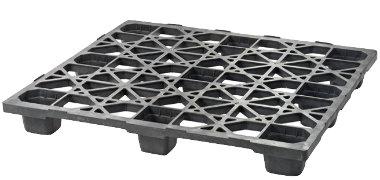


Pallet Racking
Rackable Pallets: Structure Matters
Rackable pallets must be stiff enough to safely bridge a span.

In my last post we discussed 7 basic types of pallet racks. Now that we know EVERYTHING (well, almost everything) there is to know about pallet racking, let’s talk about how pallets interact with racks and why structure matters.
When is a Pallet Rackable?
We often hear the term rackable plastic pallet but what does that really mean? Traditionally we think of wood pallets as setting the standard for rackability. Simply stated, any pallet, plastic or wood is rackable when it has the capacity to bridge a span. Remember the span? This is the open space between supports in a rack. Let’s recap:
- Beam Rack
span is the distance between the front and back beams parallel to the aisle - Edge Rack
span is the distance between rails or edges perpendicular to the aisle - Roller Rack
span is the distance between roller sets, often like the edge rack but may have a center roller set eliminating the span - Push Back Rack
span is determined by the design of the platform - Flow Rack
like a roller rack but with a pitch to move pallets along by gravity - Cantilever Rack
span is determined by the space between perpendicular beams - Supported Rack
no span
So is it that easy? As long as the pallet is rated on the spec sheet for a racking load of say 2,200 pounds and our loads match the weight, we are good to go, right? Not necessarily.
Pallet Design Matters
There are two basic design elements we need to consider:
- Structure
- Material
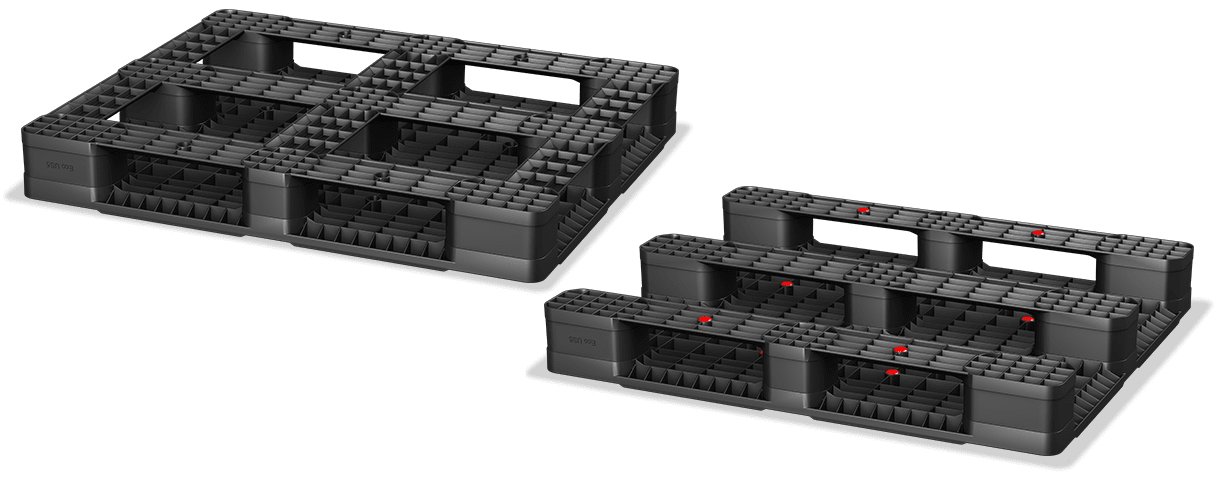
Examples of rackable pallet bottoms: full frame with cruciform base (L) and three runner (R)
Full Frame Cruciform Pallet
If we are looking at a simple beam rack with a front and back beam parallel to the aisle, the underside of the pallet should have enough structure to safely target on those beams. A full frame cruciform pallet provides runners in both directions allowing the pallet to be racked in both dimensions.
Three Runner Pallet
In the case of the three runner pallet, the pallet should only be placed in the rack with the runners perpendicular to the beams.
Pallets for Edge Racks
A pallet must have a bottom structure that will safely rest on the edge. Pallets with a radius on the runners (or heaven forbid a pallet that just has feet for support) is not suitable. Trying to target these types of pallets on racks with narrow edges would be like wire walking. Works if you’re one of The Flying Wallendas, not so much for the average forklift operator.
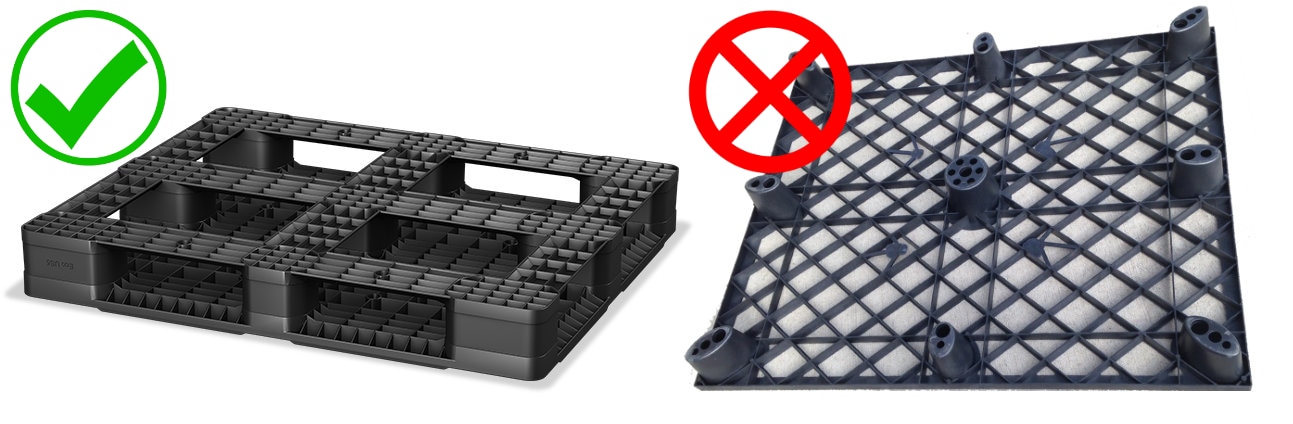
Edge racking? The left pallet is a “go” but it’s a “no go” for the pallet on the right.
Pallets for Roller Racks
Any part of the pallet bottom that interfaces (there I geek again) with the rollers should be smooth enough to flow on the rollers without chattering or bumping along. Why? We don’t want vibration to transfer to the load. Many plastic pallets tend to have ribbing in the understructure. In this case, the tighter the ribbing pattern the better.
Pallets for Push Back Racks
The design of the platform being pushed back determines whether or not a full frame pallet, runner pallet or even a pallet with just legs may be suitable. Some platforms are fully solid while others have a frame like this one pictured below.

Push back rack (L) and cantilever rack (R).
Pallets for Cantilever Racks
Structure matters and the underside of the pallet should have enough length to safely reach from one rack arm to the next. As cantilever racking is often used for longer items like siding or lengths of tubing, pallets would need to be specifically designed to handle those lengthy items in relationship to the racks intended for use.
Pallet Structure is just the Beginning
Now you know the basics of how pallet structure can impact how that pallet will work in the most common racking systems found in industry today. If you still have questions, let’s connect.
Note: For the purpose of this post, we assumed that the pallets were stiff enough to safely bridge the span without unacceptable deflection (bending) cracking or breaking. Watch for my next installment on how we make pallets stiff enough to bridge the span in the first place.
Use of racking system photos used with permission from our friends at Warehouse Rack & Shelf, LLC.