

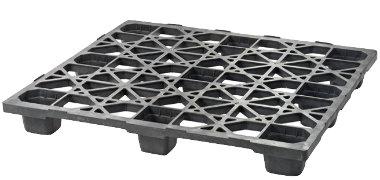


Material for Racking
Racking: Is your Pallet Material up for the Job?
Plastic materials for rackable pallets need to balance stiffness with toughness and impact resistance.

In my last post we talked about how the STRUCTURE of a plastic pallet can impact the way it interfaces with pallet racking. In this discussion, we will address MATERIAL as it relates to the rackability of a plastic pallet.
For our purposes here, we will assume our pallets need to bridge an open span in a rack. If you haven’t been following along in this series, check out my 7 Ways to Use Rackable Pallets post to get up-to-speed.
Stiffness Matters
Again, assuming our pallet has the proper structure to target on the rack safely, what is the main pallet characteristic for allowing it to bridge the span without deflecting? STIFFNESS! And yes, this actually is a technical term that can be measured.
Plastic resin producers have ways of testing various plastic materials and coming up with numbers to reflect properties best suited to an application. These plastic materials can vary in:
- Stiffness
- Stretchiness
- Stress resistance
- Squishiness
- Toughness
Loads can Complicate Things
The bottom line for us is using a material that is stiff enough to bridge our span carrying a load. Load? Did someone mention a load? For our purposes here, we will assume our loads are evenly distributed across the surface of our pallets. The nature of a load can certainly impact the performance of a pallet, but the subject is complex enough that we will leave load configuration for another day.
Stiffness can be Achieved in Several Ways
Native Stiffness
Native stiffness is measured by its (are you ready for this?) flexural modulus of elasticity. In English, this means how the material bends when subjected to force. Some materials are simply stiffer than others depending on their molecular makeup. So we just choose the stiffest possible material available, right? Not so fast! When it comes to pallets, we need to balance stiffness with toughness and impact resistance.
For most commodities plastic, if we get really really stiff we also get brittle and that is bad news to a device that is intended to work in high impact environments. This would be a good time to mention that native stiffness can be affected by temperature. When tested for the properties mentioned above, most labs use 73 degrees F as the ambient temperature during a test. Hotter environments can cause plastic to “creep” increasing deflection over time. And let’s not forget that stiffness increases as vertical depth increases. For our purposes we will assume pallets with a height of about 6 inches. Deeper would be stiffer, but pallets that are too high steal valuable load space.
Loading or Filling
Plastic material can be fortified with a filler material that will add stiffness and create what is essentially a plastic composite. Some fillers like powdered minerals or cellulose fibers will add stiffness but can also make pallets less impact resistant. Short glass fibers can add stiffness but might be shed if subjected to impact.

Usually square and made of steel, rod inserts can add stiffness to a plastic pallet for racking.
Reinforcement
If a manufacturer has settled on a plastic material that has all of the physical characteristics he desires except stiffness, a pallet can be made stiff by introducing a bar, rod or beam into the structure of the pallet for achieving the stiffness and load rating desired. The most common reinforcement material is steel. These square tubes are placed in either the deck or the bottom frame of the pallet in the direction of the span. In some cases, rods can be placed in both directions making the pallet fully rackable regardless of how it is placed in the rack.
We also find pallets strengthened with fiber reinforced beams. These little I-beams are made of dense thermoset resin reinforced with long fiber glass. As these beams are encased in the structure of the pallet, impact to the beams themselves is rarely an issue.

Fiber reinforced beams like these are better protected from impact due to being encased in the pallet.
Most Plastic Pallet Materials allow for Rackability
In conclusion, it is safe to say that most commodities plastics used to mold plastic pallets today allow a certain degree of rackability with only a well-designed structure and the native stiffness of the plastic. A common target “racking load rating” for a 48×40 full frame plastic pallet is 2200 pounds. Although not universal, this is a common target. Most certainly if higher racking ratings are required, the introduction of either fillers to create a stiffer composite or some form of reinforcement rods would be needed.
If you still have questions about how material or structure apply to the selection of a rackable plastic pallet, let’s connect. And, be sure to watch for my next post on the unit load itself and how load configuration can impact how a pallet will behave in a rack.